
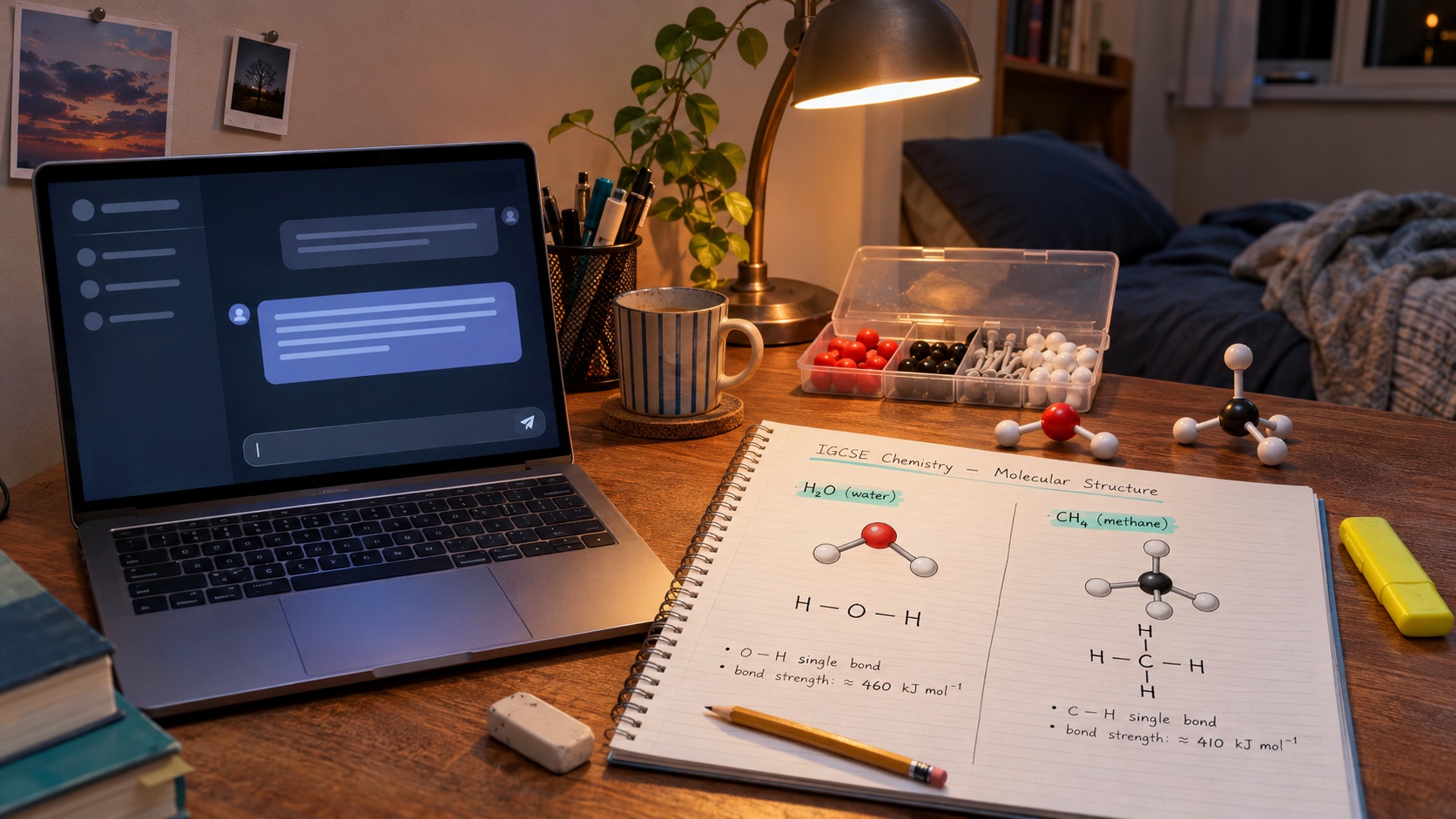
Wednesday night. My chemistry notebook is open at two diagrams. One is water. The other is nitrogen. I can draw the shared electrons for both. I can also copy the sentence beside them. “The molecule is stable because it has strong bonds.” The sentence looks neat. I still do not know what each word is doing.
I opened Copilot Learn on my Copilot Pro account because I want to revise by thinking, not by collecting more highlighted sentences. There is one thing to get clear first. Microsoft has changed the name. The “Study and learn mode” from its older Copilot pages is now called “Guided Learning” in the updated app.
I opened Copilot Learn on the web, chose the Tools tab and selected “Guided learning with Copilot”. I typed my chemistry topic into “Message Copilot”. The help page says this tool guides me step by step instead of just giving a direct answer. Copilot Learn also has quiz, flashcard, visual learning and practice test tools. I wanted one idea at a time, so the quiz cards could wait.
Then I typed my old sentence into the chat. The first question made me define stable. I realised I was mixing the bond, the molecule and the forces between molecules. That is where my confusion starts.
A strong covalent bond needs a lot of energy to break. The O–H bond in water is about 460 kJ per mole and the average C–H bond is about 415. Those numbers are large, so covalent bonds normally survive melting or boiling. Molecules move apart, but atoms inside each molecule usually stay together.
A stable molecule is a bigger question. Stable compared with what? At what temperature? A molecule can have strong bonds and still react. It depends on the other chemicals, the products and the energy barrier. This is why exam wording matters. “Strong covalent bonds” describes the bonds. “A stable molecule” describes the whole molecule in a given situation.
Nitrogen is a good test. The N≡N triple bond has a very high bond enthalpy of about 945 kJ per mole. It is almost twice the 498 kJ for an O=O double bond. An N₂ molecule is very unreactive at room temperature. A simple explanation says it is inert because the triple bond is strong. That is only part of the story. Breaking the bond needs a high activation energy. Making nitrogen react usually needs difficult conditions or a catalyst. Bond strength matters, but stability also depends on what can happen next.
Water shows another trap. When water boils, I do not break every O–H bond. I overcome the weak forces between water molecules. The covalent bonds stay in place. I used to call this “breaking water”. Now I say “separating the water molecules”. The meaning changes completely.
Methane is the opposite test. It has strong C–H bonds, but it can burn. A reaction can happen even when each bond is hard to break if the reaction path has products that are much lower in energy. So a strong bond does not mean the molecule will never react.
Back at my notebook, I stopped writing “stable bond” as if it were one thing. I wrote two sentences instead.
- The covalent bonds in H₂O are strong.
- A water molecule is stable under normal conditions.
These sentences are doing different jobs. The first one is about the bond. The second one is about the whole molecule and its surroundings.
Guided Learning did not hand me a perfect paragraph. It slowed me down and made me try again. My answer became more awkward before it became clearer. That is probably what revision should feel like.
At the end, the page was less neat. N₂ had a note about a catalyst. Water had a sentence saying “boiling is not breaking the molecule”. I kept both notes. A definition can look clean until the next example arrives.
Microsoft’s transparency note says Copilot can make mistakes and even present false facts in a confident way. I checked the bond energy numbers after the chat. Guided Learning helps me think, but it does not become my answer sheet.
Checked. Microsoft’s Copilot Learn instructions, app change note and transparency note, OpenStax’s bond-strength section, LibreTexts’ bond-energy table and the Cambridge IGCSE Chemistry syllabus.