
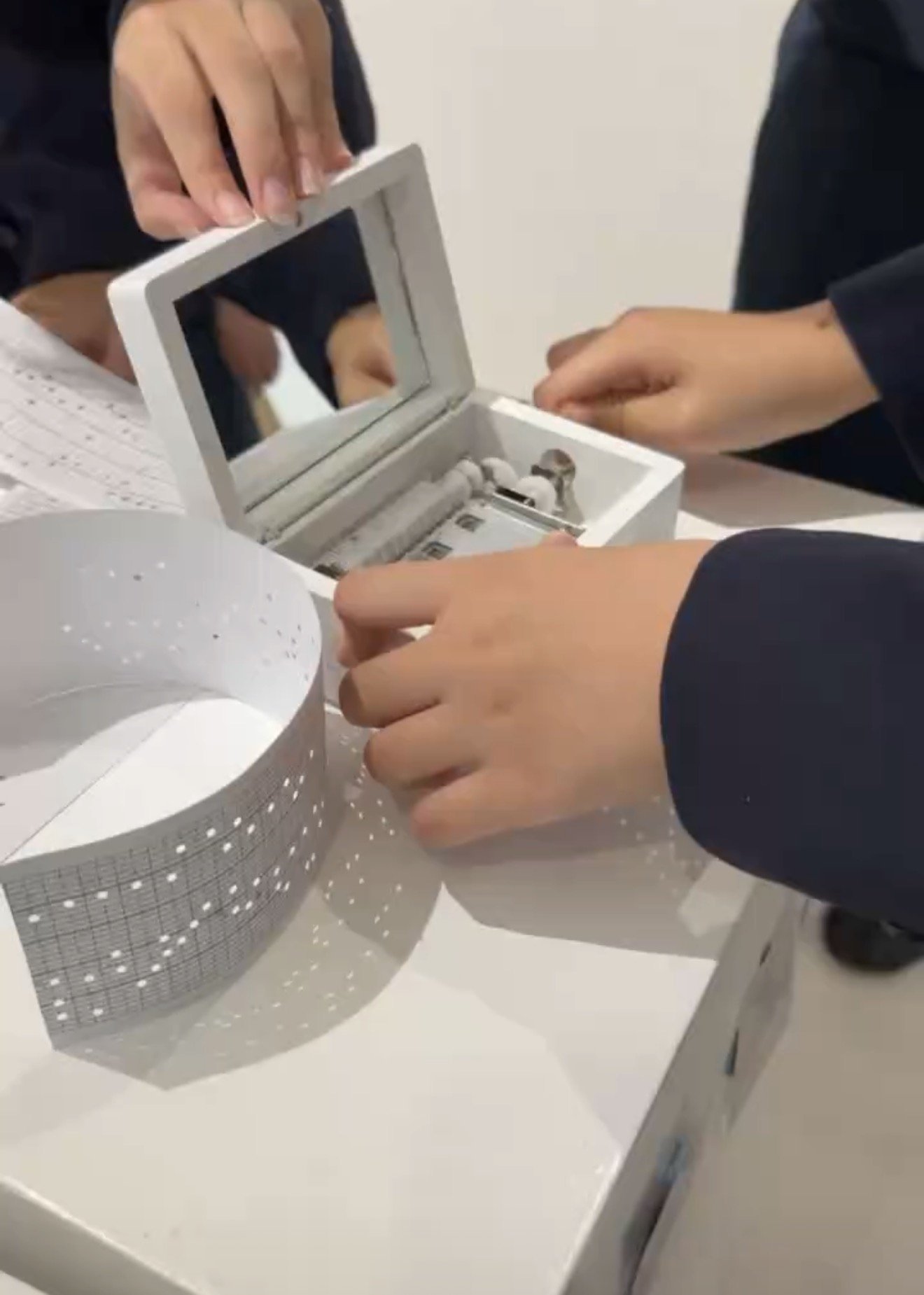
Today was the exhibition for my Year 9 capstone, 2 June, and the whole project fit in a white box you can hold in two hands. It is a music box, but not the kind that only know one lullaby forever. I choose a song I actually like, edit it into MIDI, and then turn those notes into holes on a strip of card. When you feed the paper through and turn the crank, the pins drop into the holes and the comb play the tune back. It is a little like a phonograph, except the record is a piece of homework I cut myself.
I used to think a song live in a phone. You press play, and the sound arrive as if it always been there. MIDI is less polite than that. On the screen it look like a piano roll: dots sitting on a grid, each one a pitch and a moment in time. I put that screen into my presentation slides, next to the real paper, because I want people to see that the holes and the dots are the same song in two languages. If I put a note too early, the melody lean forward. If I stack too many notes in one place, the little comb cannot play them all, because a paper music box only have so many teeth. I have to thin the arrangement until it sound simple enough to be true.
The next step feel almost old-fashioned. I print the pattern onto card with a grey grid, then punch the holes, one by one. A wrong hole is not a wrong pixel. You cannot undo it with a finger. I waste one strip by putting a run of notes too close together, and the paper tear when I try to fix it. The second strip is slower. I check the MIDI against the card the way I check a Maths answer against the question, except the answer here is a sound I will not hear until the paper go into the box.
At the table today someone else turn the crank and I hold the lid. The paper curl like a small white snake. For a second nothing happen, and I think I punch the silence. Then the first notes come out, thin and metallic, and I recognise the song even though it no longer have drums or a singer. It is the skeleton of the piece, the part that can survive being turned into holes.
I keep thinking about price and value, which is a habit I cannot switch off since Business start. A shop music box is cheap and finished. You buy a melody that someone else choose, and it will be that melody until the spring die. Mine cost more time than money. The MIDI file is free. The card is ordinary. The expensive part is sitting there, deciding which notes are allowed to live. That is a kind of editing I like: not making the song fancier, but making it small enough to become physical.
People keep asking what the paper is for, as if a grid of holes could not possibly be music. I want to say that a lot of the music we stream is also a grid, only the holes are invisible and the crank is a thumb. I do not say that. I just ask if they want to turn it again.
I am glad this was the last big project of junior high. It sit next to my other subjects without asking permission. Music is the feeling. Maths is the spacing. Business is the question of what you give up to make one version of a song instead of another. ESL is me trying to explain all of that without make it sound like a manual.
The box is closed now, with the paper rolled beside it. If I want the song, I have to put the strip in and turn the handle. I like that it will not play itself. I have to mean it.