
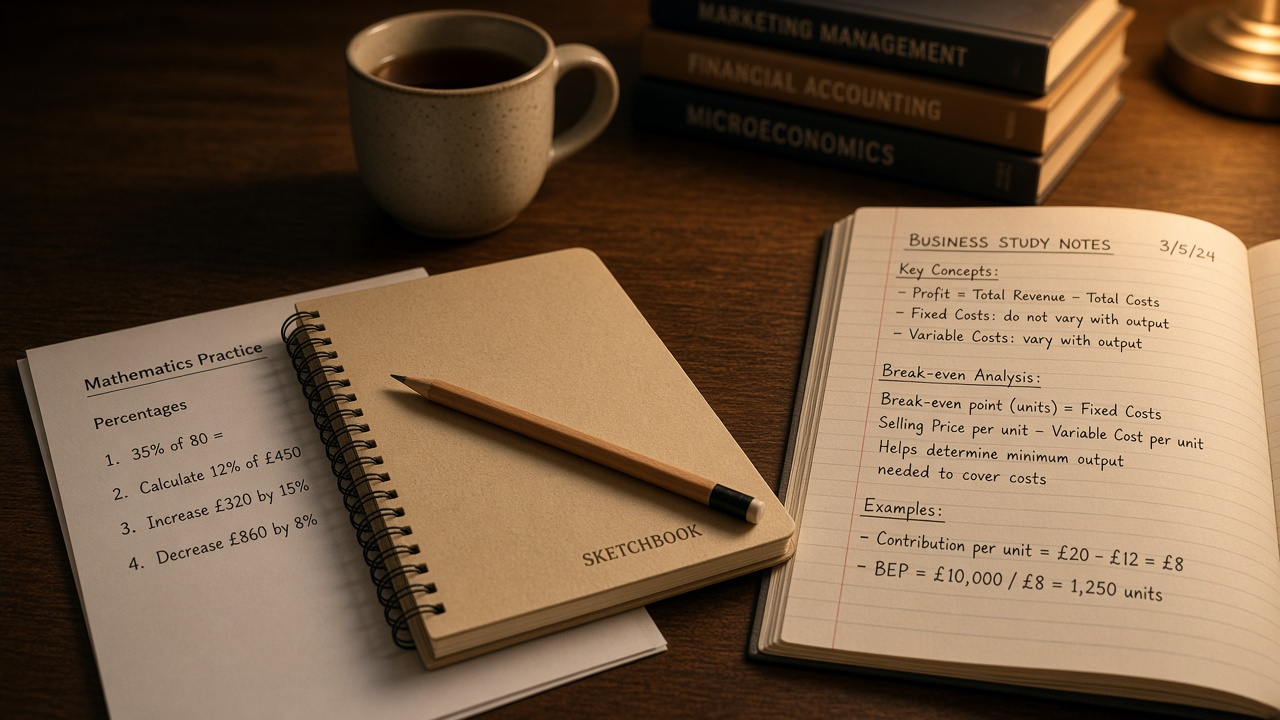
Tuesday night, and my Business notes are open to opportunity cost. The definition looks neat: the next best alternative you give up when you choose something else. On the worksheet it is always a factory choosing between machines. On my desk it is quieter and harder to pretend I do not understand.
I had already started a small commission sketch before I opened the book. The pencil was still warm in my hand. Maths practice was underneath the sketchbook, the kind with percentages and currency conversions that Business keeps borrowing from. I told myself I would finish “just the face” and then switch. Just the face became the hair. The hair became another twenty minutes I did not write down anywhere.
Opportunity cost is not the thing you buy. It is the thing you do not get because you bought the first thing with your time. Tonight the first thing was a drawing that might turn into money later. The next best use of the same hour was the practice set that will not email me a transfer, but will show up on a paper that does not care how pretty the character looked.
I used to treat that trade-off like a mood. If I felt creative, drawing won. If I felt guilty, homework won. Business wants the choice named, not romanticised. Naming it does not make me stop drawing. It stops me from calling the skipped Maths page “nothing,” as if unused paper has no price.
In the notes I wrote my own example under the factory one. Choice A: finish the sketch. Choice B: thirty percentage questions. Cost of A is the clear practice I did not do. Cost of B is the unfinished face and the client waiting one more evening. Both costs are real. Only one of them shows up in a materials list.
I am aiming at finance later, and people act like that means loving spreadsheets. What it actually means, at least for me, is getting honest about trade-offs before the numbers get big. An hour is small. Calling it free is how you practise being wrong about value.
I closed the sketchbook on the unfinished face and did one side of the Maths sheet. Not because drawing is a waste. Because opportunity cost only helps if I am willing to pay it on purpose, instead of discovering tomorrow that I paid it by accident.