
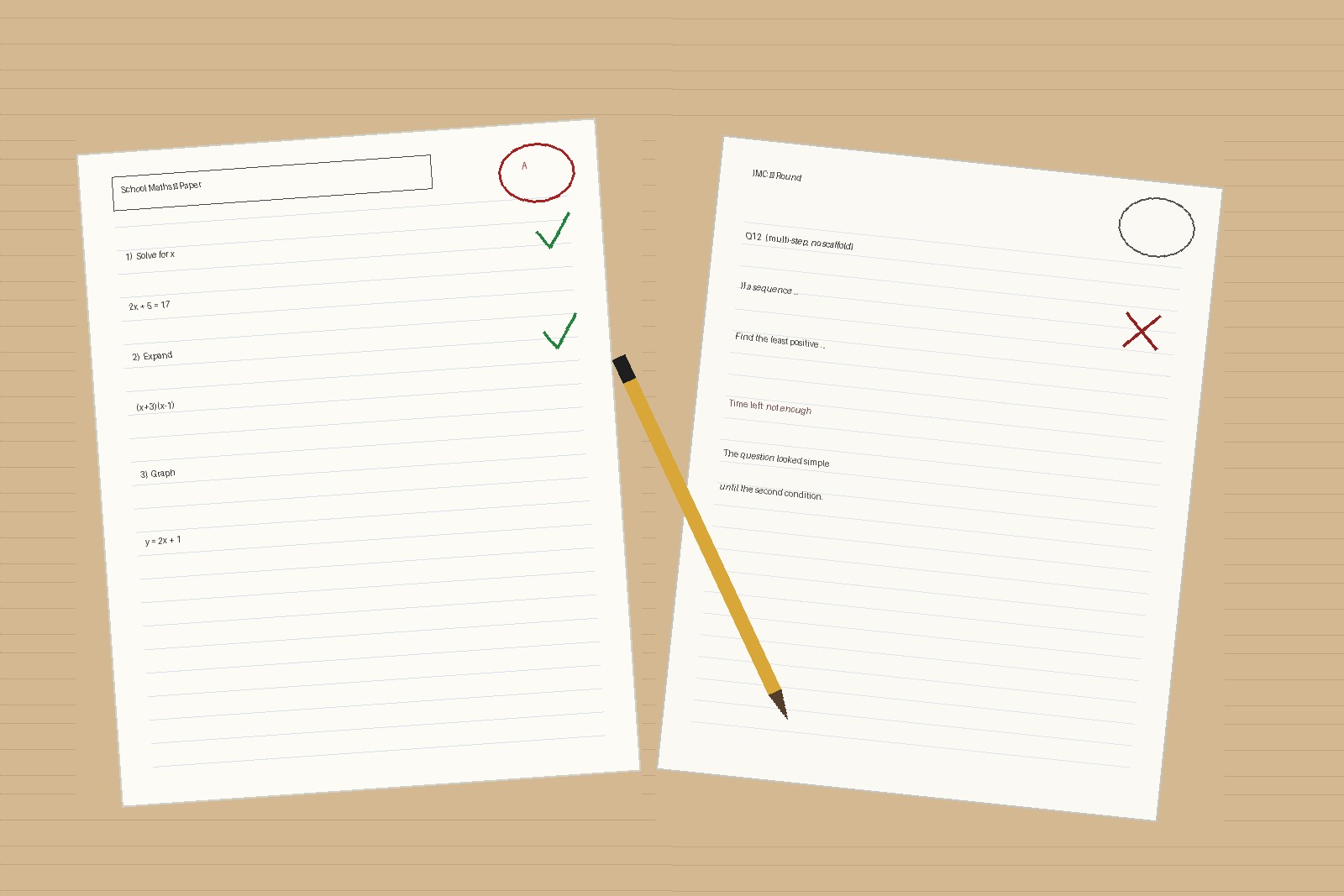
Monday night, and both papers are still on my desk even though the results arrived days apart. One is school Maths, the kind we practise every week until the method feels familiar. The other is from IMC, a contest I walked into thinking an A at school would travel with me. It did not.
School Maths gave me an A, and I am not pretending that means nothing. The questions asked for skills I recognise: rearrange, expand, plot, check the units, show the steps the teacher has already modelled. When I got stuck, there was usually a scaffold nearby, or at least a shape I had seen before. Hard work showed up as marks, which is a fair kind of fairness.
IMC felt like a different language using the same alphabet. A question looked short on the page, almost friendly, until the second condition arrived and the path I trusted ended. There was less room to earn partial credit by being neat. Time did not stretch for the careful student who needs one more line. I left a few blanks that still bother me when I walk past the folder.
For a day I treated the quieter contest score as a correction of the A, as if only one of them could be true. That was a lazy way to read two pieces of evidence. School Maths tests whether I can carry a method through under known conditions. The contest tests whether I can invent a route when the method is not hanging on the wall. Both are maths. They are not the same exam wearing different logos.
I still want the A. I also want to get less flustered when a problem refuses to look like homework. So I am keeping both papers, not as a ranking of who I am, but as a reminder that one number never finishes the story. Tomorrow I will go back to the IMC question I abandoned and try it without the clock, just to see whether the idea was missing or only the minutes were.