
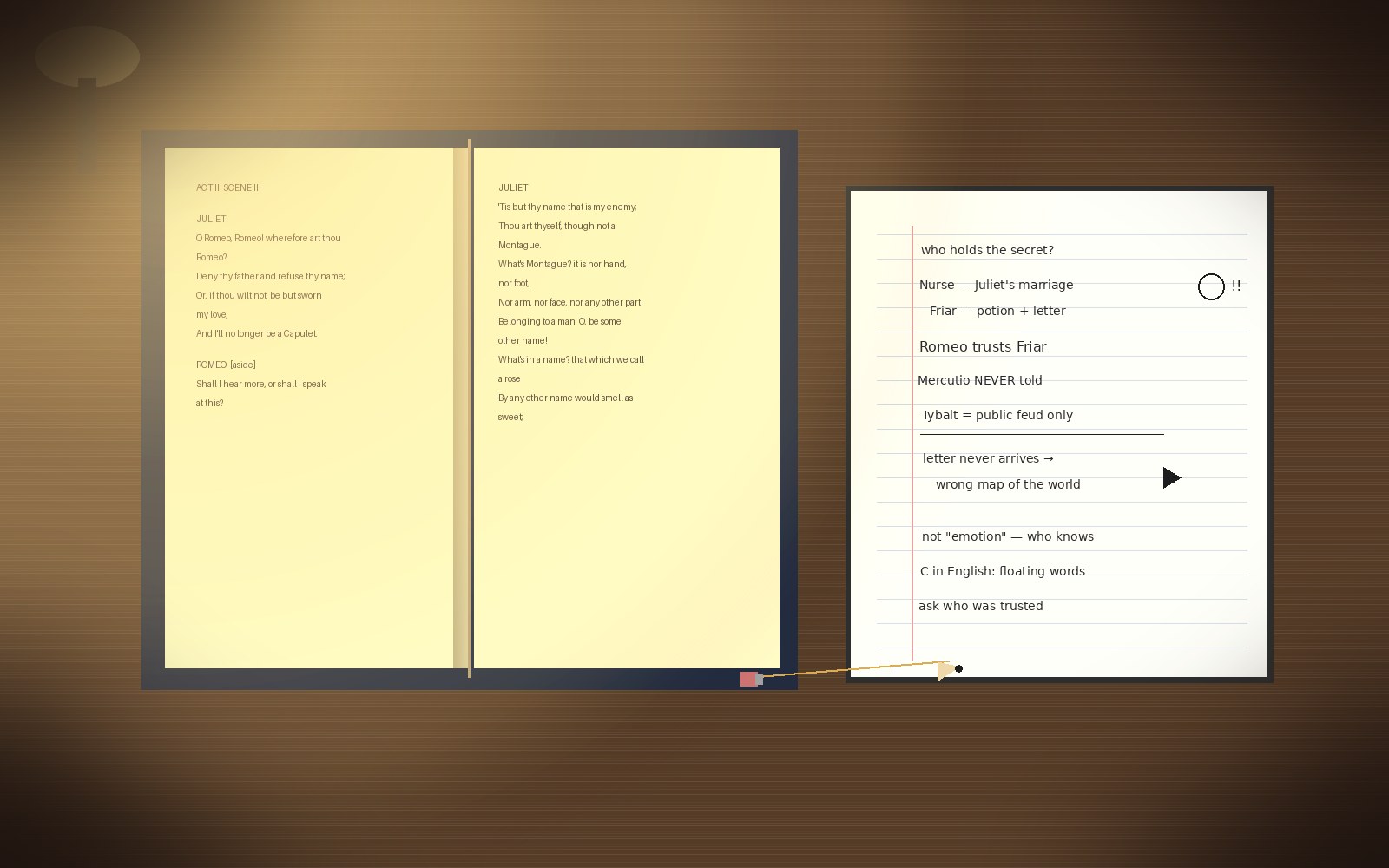
Friday night, and the Romeo and Juliet notes are open again, the ones that earned me a C in English. Not because I skipped the reading. I knew the plot. I could even list the deaths in order. What I could not do was write a paragraph that started with “they feel” and then keep going without sounding as if I had borrowed the sentence from a worksheet.
Love, hate, jealousy: the words sat on the page like labels on jars. They were not wrong. They also did not help me see how the play tightens. So this week I tried a smaller question, the kind I can actually answer with a pencil in the margin. Who is trusted with a secret, and who is left outside it?
Juliet trusts the Nurse with the marriage plan. That is not a feeling. It is a decision about whose ear is safe. Romeo trusts Friar Laurence with the same secret, and later with a plan that involves a potion and a letter. Mercutio, who talks as if he knows everything, is never given that private map. Tybalt moves on the public feud, not on the private truth that a Capulet and a Montague have already married in secret. Once I wrote those names in a column, the play stopped floating.
The tragedy, I am starting to think, is not only that people love too hard. It is that the wrong person holds the secret, or that a secret never reaches the person who needed it. The letter meant for Romeo is the clearest example. Friar John cannot deliver it. Romeo never learns what Juliet has risked to stay alive. He acts on the version of the world he still believes, which is incomplete, and incompleteness turns out to be deadly.
In class I used to chase emotion words because that seemed like analysis. Now I chase who knows what. When Juliet speaks to the Nurse, the room feels different from when she speaks to her mother. When Romeo kneels in the Friar’s cell, he is not only in love; he is handing someone else the power to keep him safe or to fail him. That is a concrete thing I can underline. It does not ask me to invent a weather report for a heart I cannot hear.
I still struggle when a question says “analyse the emotion.” The word is too wide, and I get lost inside it. Asking who keeps the secret is narrower, and somehow kinder. It gives me a door into the same play without pretending I already understand every feeling Shakespeare put on stage.
The paperback is face down on my desk with a pencil stuck in Act 3. Tomorrow I may still freeze if someone asks me to describe Romeo’s passion in three adjectives. Tonight, at least, I can say who was trusted, who was not, and where the silence did the damage.