
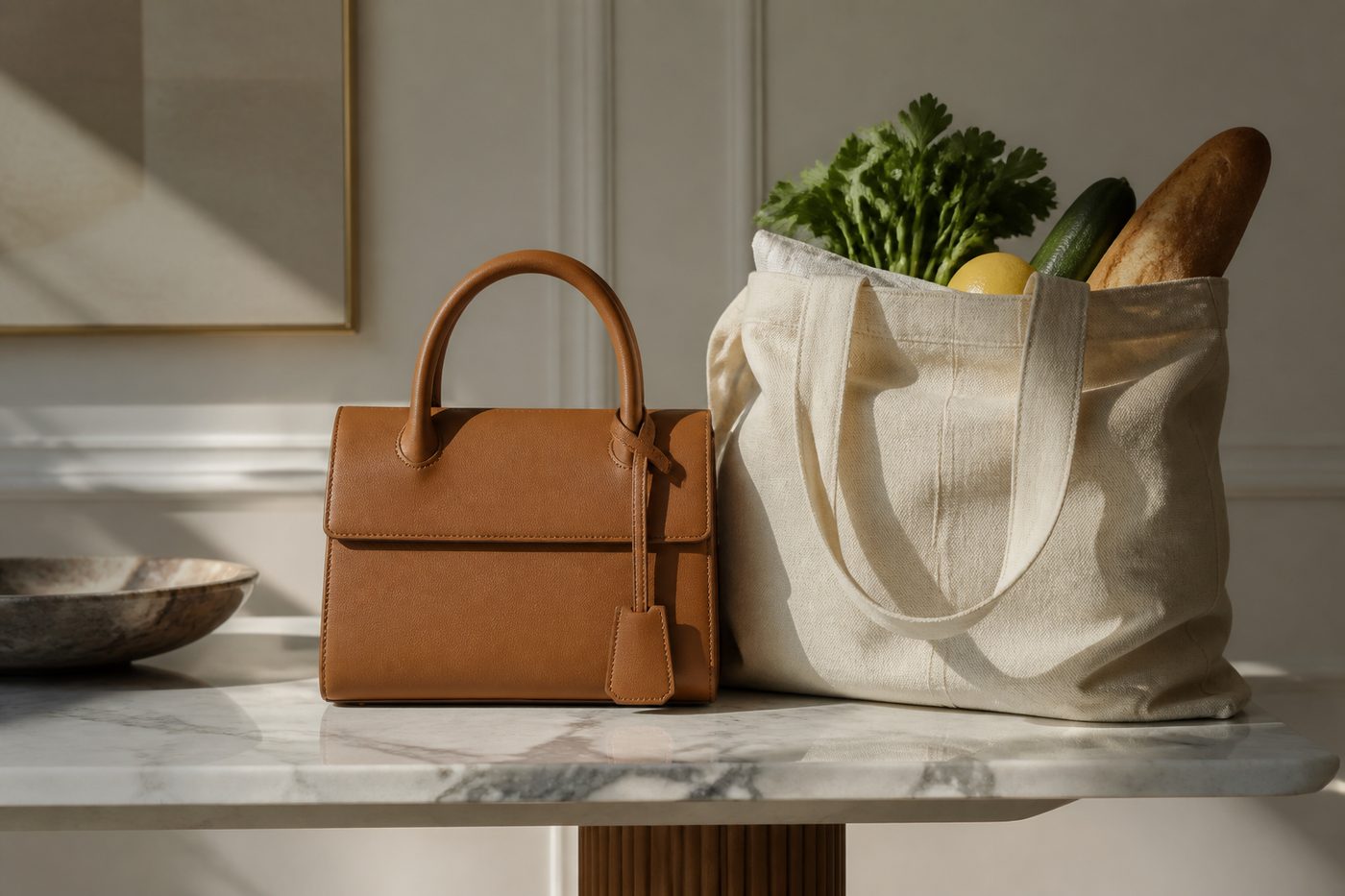
There is a window in town with a bag on a pedestal, lit as if it were a small painting. I do not want the bag. I want to understand why the lighting is so sure of itself, and why I slow down anyway.
On 27 July, LVMH — Louis Vuitton, Dior, Tiffany, Bulgari — say second-quarter sales rise 3% organically, in line with what people expect. US sales are up 6%, helped by newly rich tech and AI money. Watches and jewellery jump 11%. Europe is weaker because the Iran war hit tourism. Revenue for the first half of 2026 is €38.6 billion. A year earlier, full-year 2025 revenue slip to €80.8 billion. Bernard Arnault already warn that 2026 “won’t be simple.”
It has not been simple. Holiday flights get more expensive and more awkward, which is a strange background for a shop window that still look calm. And still the handbags sold, especially in America, to people whose money arrive recently and want a logo to prove it had arrived.
In Business this is branding, and it is also income elasticity, a phrase I like as soon as it stop sounding like a rubber band. Elasticity here mean how much demand move when income move. Extra income do not make you eat twice as much ordinary bread. Extra income can make you buy the watch you were only looking at. Demand for luxury can hold up, or even jump, when other spending crack, because the point of the object is not only the object. The point is to be seen having paid, or to feel, privately, that you are the sort of person who can.
I keep putting that next to the supermarket own-brand tin. Same species of decision, different lighting. One fight is to stay cheap so nobody leave. The other is to stay expensive on purpose, so the right people stay. Both are about who you think you are in the aisle, except one aisle have a pedestal.
Europe being weaker make sense in a grim way. If tourists cannot fly in, or will not pay the new fares, the shops that live on people passing through a city go quieter. The US number is the other half of the same year: some people get richer from tech and AI, and they still want jewellery. I do not know those people. I know the window, and I know the difference between a logo bag and a bag that only have to carry books.
I think of the girl in The Nightingale and the Rose, the one who want jewels, not the flower that cost a life. She would have understand the pedestal. She would not have understand the flight prices, and she would not have cared. That used to annoy me as a character note. Now it look like a customer group.
I am not going to buy the bag. I am going to keep walking past the glass and asking the finance question I also ask in literature: who is this priced for, and what do they think they are buying when they say yes?
Arnault say the year would not be simple. He was right. For some tills, it was still good enough.